
How to Choose the Right Crane Size for Your Lift (UAE Guide)
Load weight, working radius, lift height — the three numbers that size every crane, read against the load chart at 75–85% capacity. Plus UAE hire rates and the mistakes that end in a re-mobilization fee.
Book a crane that's too small and you'll find out at the worst possible moment — with the load rigged, the crew standing around, and a re-mobilization fee heading your way. Book one that's too big and you've paid for capacity, transport, and permits you never needed.
The rest of this guide walks you through how to get those numbers right, with a real example from start to finish. By the end, you'll know roughly what tonnage to ask for when you request a quote.
On this page
The 4-Step Method to Size a Crane
Let's work through a lift we see all the time: a 4-ton packaged AC unit going onto the roof of a 25-metre building in Sharjah, with the crane set up 18 metres from where the unit lands.
Step 1: Work Out the True Load Weight
The number on the equipment nameplate is not the number the crane lifts.
Your gross load is the payload plus everything hanging with it: the hook block (which alone can weigh 300–500 kg on bigger cranes), slings, shackles, and a spreader beam if the load needs one. Rigging routinely adds half a ton or more.
Then add a 10–25% contingency. Weights on delivery notes are often dry weights — a chiller that ships with refrigerant and packaging, or a water tank with residual water, can be meaningfully heavier than its datasheet says.
Where to find real weights: the manufacturer's nameplate, the supplier's delivery documents, or the technical datasheet. If you're guessing, guess high — the crane doesn't care about optimism.
Step 2: Measure the Working Radius (The Number That Matters Most)
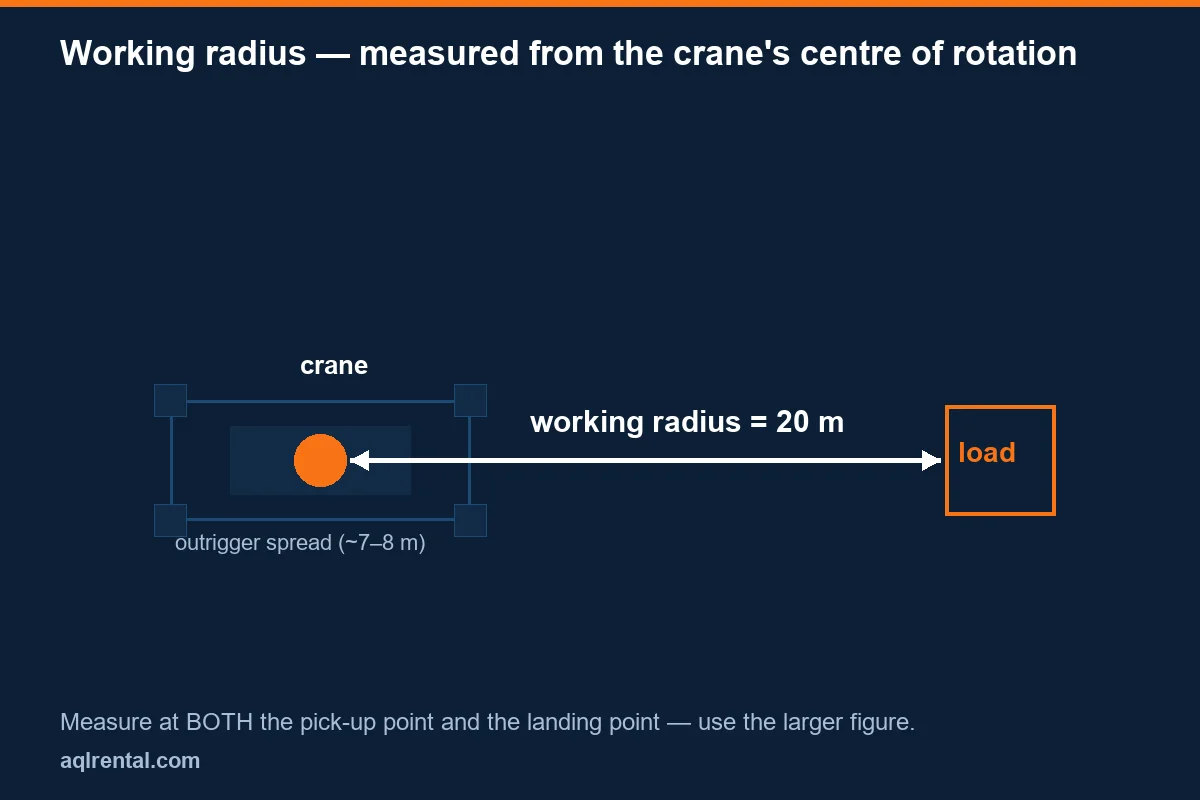
Working radius is the horizontal distance from the centre of the crane's rotation to the centre of the load — measured at the pick-up point and the landing point. Use whichever is larger.
This is where most sizing mistakes happen, because people assume the crane can park right next to the building. It usually can't. Setback distances, boundary walls, parked vehicles, and the crane's own outrigger spread (often 7–8 metres across) all push the machine further out than you'd like.
Measure it properly: from a site plan, with a laser rangefinder, or by pacing it out and adding a safety margin. Don't eyeball it from memory.
Step 3: Check Lift Height and Obstructions
Lift height isn't just the building height. You need the height to the landing point, plus clearance to swing the load over the parapet, plus the length of the rigging under the hook.
The boom also has to clear the roof edge at an angle — which often forces a longer boom, and a longer boom at the same radius means less capacity.
While you're looking up, look around: power lines, adjacent buildings, tower cranes on neighbouring plots. In dense areas of Dubai and Sharjah, the swing path matters as much as the lift itself.
Step 4: Read the Load Chart at 75–85%
Every crane comes with a load chart — a table from the manufacturer showing exactly what it can lift at each combination of boom length and radius. It's the only document that answers "can this crane do this lift?" (Here's what one looks like: a manufacturer's load chart for a 50-ton Liebherr.)
One rule the industry lives by: plan your lift at no more than 75–85% of chart capacity (you'll also see this expressed against the crane's safe working load, or SWL). The margin covers wind, the slight jerk of the load coming off its supports, and the honest possibility that your weight estimate is off.
Notice what happened there: a 4-ton load ended up needing a 100-ton crane. Which brings us to the trap that catches almost everyone.
The Radius Trap: Why a "50-Ton Crane" Can't Lift 50 Tons on Your Site
The tonnage in a crane's name is its maximum capacity at minimum radius — usually with the load practically touching the carrier, boom nearly vertical. Move the load away from the crane and capacity falls off a cliff.
Here's an indicative capacity curve for a typical 50-ton mobile crane:
| Working radius | Approximate lifting capacity |
|---|---|
| 3 m | 50 t |
| 8 m | ~18 t |
| 12 m | ~12 t |
| 16 m | ~8 t |
| 24 m | ~4.5 t |
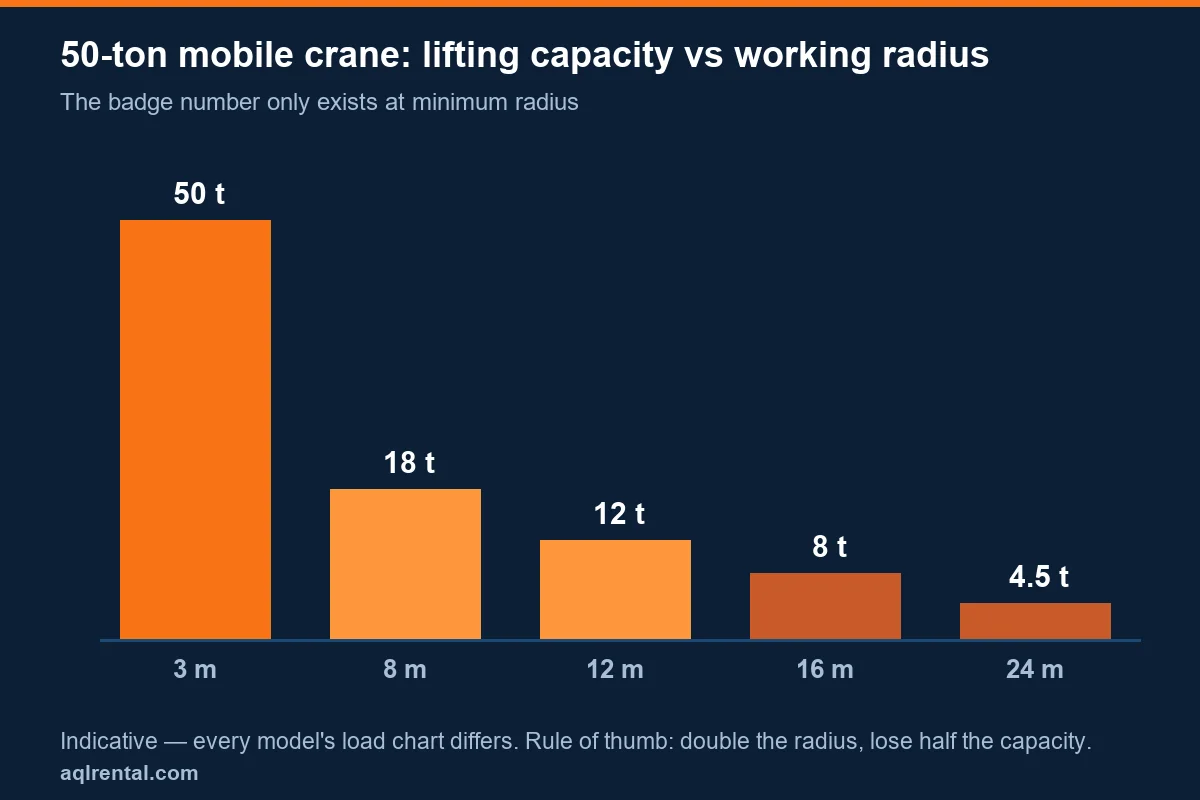
A rough rule of thumb: double the radius, and you lose half your capacity or more. So when a rental company asks "how far will the crane sit from the load?" before asking what the load weighs, that's not small talk. That's the sizing question.
Crane Size Chart: Which Tonnage for Which Job in the UAE
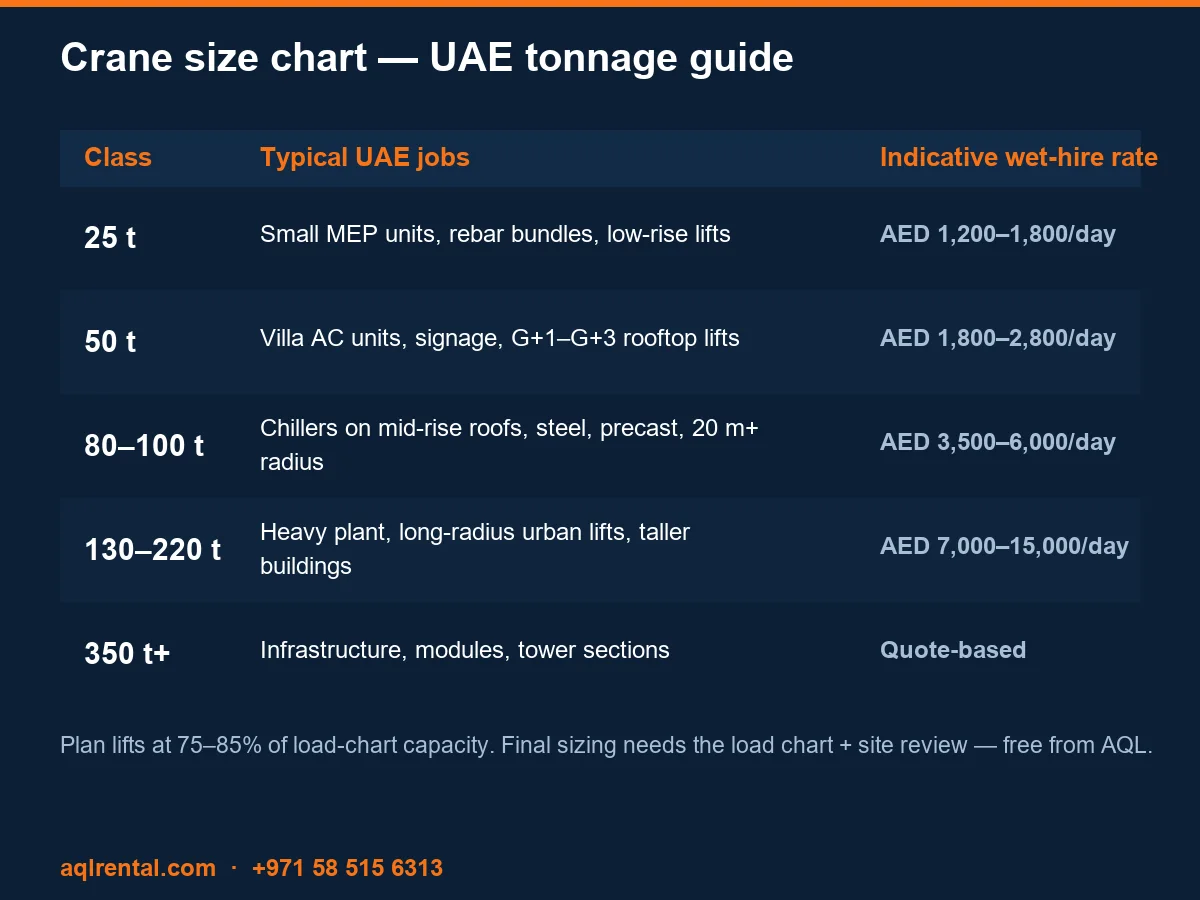
Most of our customers don't think in load charts — they think in jobs. Treat this table as a quick crane size calculator until you have the actual load chart in hand: it maps the common tonnage classes in our mobile crane rental fleet to the work we typically see them doing across Dubai, Sharjah, and Abu Dhabi:
| Crane class | Typical UAE jobs | Practical reach | Indicative day rate (wet hire) | Site space needed |
|---|---|---|---|---|
| 25 t | Small MEP units, rebar and timber bundles, low-rise lifts at short radius | Short radius, up to ~G+2 | AED 1,200–1,800 | Small — fits tight plots |
| 50 t | Villa AC units, signage, small pool shells, G+1–G+3 rooftop lifts | Moderate radius, mid-rise | AED 1,800–2,800 | ~7 m outrigger spread |
| 80–100 t | Chillers on mid-rise roofs, steel erection, precast panels, long-radius villa lifts | 20 m+ radius, ~8–10 storeys | AED 3,500–6,000 | Full outrigger spread + access |
| 130–220 t | Heavy plant, long-radius urban lifts, taller buildings | Long radius, high hook heights | AED 7,000–15,000 | Large pad + delivery access |
| 350 t+ | Infrastructure, modules, tower sections | Engineered lifts | Quote-based | Dedicated lift planning |
Not sure which class fits your lift? WhatsApp us the details — free sizing, usually same day.
If your job sits between two classes, the honest advice is usually to take the larger one. The rate difference is small compared to the cost of a crane that arrives and can't make the lift.
UAE Factors That Change the Answer
Crane sizing in the UAE isn't only physics. A few local realities regularly change which crane we recommend — or when it can work.
Heat, Wind, and When Lifts Get Called Off
Most lifts stop when wind exceeds roughly 9–10 m/s at the boom tip — and less for large, flat loads like panels that act like sails. Shamal winds and summer conditions mean we often schedule critical lifts for early morning. If your program has zero float, tell your rental company; it affects both the crane choice and the plan.
Permits, Escorts, and Moving Big Cranes
Cranes in the 100 t+ class don't just drive over. They need road permits, sometimes a police escort, and their mobilization has to work around Dubai's truck rules — which changed again this year. We covered the details in our guide to Dubai truck ban hours and permit rules for 2026. Build mobilization time into your schedule for anything above 100 tons.
Ground Conditions and Outrigger Space
A mobile crane pushes enormous point loads through its outriggers — and sandy or reclaimed ground, backfilled trenches, and underground services can all give way under them. You'll need outrigger mats, a firm level pad, and clearance from any excavation edges. Our site preparation checklist covers what to have ready before the crane arrives.
Compliance Basics
Every crane working in the UAE needs a valid third-party inspection certificate, and the operator needs certification for that machine class. Municipalities and MOHRE guidelines govern lifting operations, and inspectors do check paperwork on active sites. A reputable rental company handles all of this — but it's worth confirming before booking, not after.
The Cost of Getting Crane Size Wrong
Undersized is the expensive mistake. The crane arrives, sets up, and the chart says no. Now you're paying for an aborted lift, an idle crew, a re-mobilization fee, and a lost day — often more than the price difference between the crane classes would have been.
Oversized is the quiet mistake. Everything works, but you've paid a higher day rate, bigger transport and permit costs, and given up more site space than the job needed.
This is also where wet hire earns its keep. When the crane comes with our certified operator, the sizing risk shifts to us — we're the ones confirming the chart works before the machine leaves the yard. If you're weighing the options, our wet hire vs dry hire cost breakdown runs the real numbers.
What to Tell Us for an Accurate Quote
Send us these details and we'll size the lift for you — free, usually same day:
- Load: weight and dimensions (nameplate or datasheet if you have it)
- Pick and set points: where the load starts and where it lands
- Working radius: how far the crane can realistically sit from the load
- Lift height: building height plus any obstructions
- Access: gate width, overhead cables, space for outriggers
- Ground: paved, compacted, sand, or near an excavation
- Timing: date, duration, and any night/early-morning constraints
- Photos or a site plan — even phone photos help enormously
FAQs
What size crane do I need to lift 5 tons?
It depends almost entirely on radius. At a short radius (under 8 m), a 25–30 ton crane may handle 5 tons easily. At 20 metres or more, you're likely looking at an 80–100 ton class machine. Work out your radius first, then check it against a load chart at 75–85% capacity.
How much does crane rental cost in the UAE?
Typical crane hire rates run: AED 1,200–1,800 per day for a 25 t crane, AED 1,800–2,800 for a 50 t, AED 3,500–6,000 for an 80–100 t, and AED 7,000+ for 130 t and above (wet hire, operator included). Mobilization, permits, and long-term discounts change the picture, so treat these as ballparks and get a firm quote.
What is the 75% rule in crane lifting?
Standard practice is to plan lifts at no more than 75–85% of the crane's chart capacity for that boom length and radius. The margin absorbs wind, dynamic loading when the load lifts off, and errors in the estimated weight.
Can a mobile crane reach the top of a 10-storey building?
Yes. A 10-storey building (roughly 35–40 m) is within reach of 100 t+ class mobile cranes, depending on the working radius and load. For much taller towers, luffing-jib configurations or tower cranes become the practical answer.
How much space does a mobile crane need on site?
A 50 t class crane typically needs around a 7–8 m outrigger spread plus room for the carrier — think a clear, level area of roughly 10 × 10 m. Larger classes need more, plus access for the crane (and counterweight trucks, for big machines) to drive in.
What's the difference between crane capacity and crane size?
“Size” (the badge number, like 50 t) is the maximum capacity at minimum radius. Real capacity on your site is whatever the load chart says at your specific radius and boom length — usually a fraction of the badge number.
Do I need a permit to bring a crane to my site in Dubai?
Large cranes need road/transport permits and must work around truck ban hours; your site may also need lifting-related approvals depending on location and lane closures. See our Dubai truck permit rules guide and UAE construction permits overview.
Does AQL crane rental include an operator?
Yes — our standard crane rental is wet hire, with a certified operator included and riggers available on request. It’s the safer option for most customers, and it puts the responsibility for sizing and executing the lift on us. Here’s the full wet vs dry hire comparison.
Key Takeaways
Three numbers decide your crane: true load weight (with rigging and contingency), working radius, and lift height — read against the load chart at no more than 75–85% capacity. Radius is the trap: a 4-ton load at 20 metres is a 100-ton crane job. And when you're between sizes, go up — or better, send us the checklist above and let us size it for you.
Planning a lift in Dubai, Sharjah, or Abu Dhabi? Get a free lift assessment or message us on WhatsApp — we'll tell you exactly what crane your job needs.