
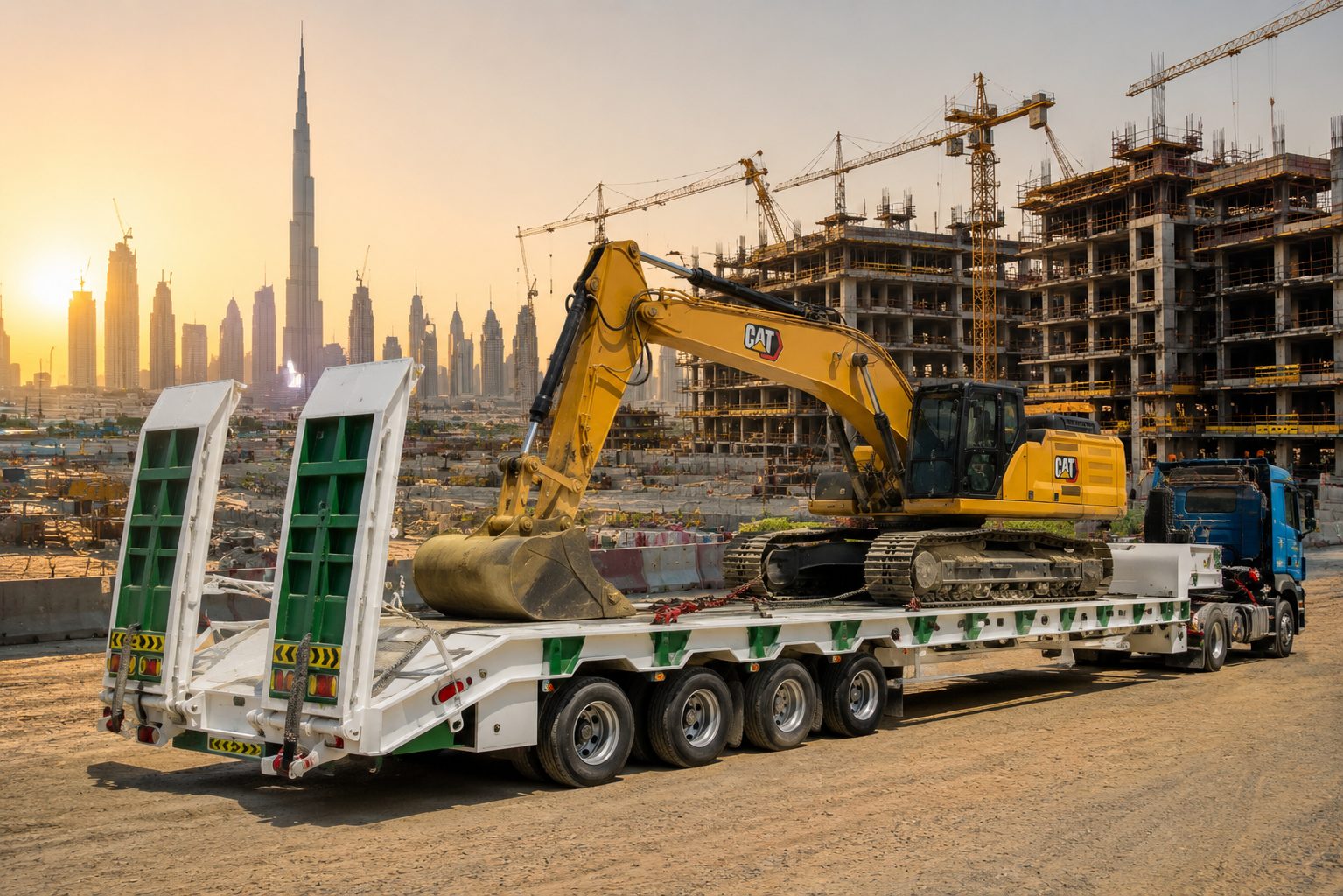
Here's a scenario we see more often than we'd like: a contractor books an excavator, the low-bed shows up on Monday morning, and the machine sits behind the hoarding for a week — because the excavation permit is still "under review." The rental clock is running. The project clock is running. Nothing is moving.
UAE construction permits are the part of the job nobody enjoys and everybody underestimates. So this guide lays it all out: which authority you actually apply to (the single biggest point of confusion), which permits you need and in what order, what they cost, how long they take, and — because we rent equipment for a living — exactly which pieces of paper need to exist before an excavator digs, a crane lifts, or a truck delivers.
Quick answer
UAE construction permits are issued per emirate — and in Dubai, per zone — by authorities like Dubai Municipality, the Dubai Development Authority (DDA), Trakhees, and Abu Dhabi's DMT. Any new build, structural modification, excavation, or demolition needs one.
Individual permits typically process in 2–5 working days once your documents are in order, but a full approval chain usually runs 4–12 weeks. Fees range from around AED 1,000 for villa-scale permits to AED 100,000+ across a large project. Applications are almost entirely online.
The permit sequence: from empty plot to completion certificate
The building permit process in the UAE isn't a single application — it's a chain, and each link has prerequisites. Miss the order and your application bounces. For a typical mid-size building project in a DDA area, the sequence looks like this:
- Land demarcation certificateConfirms your plot boundaries.
- Preliminary design approvalConsultant's design gets authority sign-off (DDA Form ZA-DC-F-03 — nothing moves without it).
- Mobilisation permitHoarding, signboard, temporary offices, first equipment on site.
- Excavation permitDigging, foundations prep, levelling.
- Shoring & piling permitsWhere ground conditions or depth demand them.
- Sub-structure permitFoundations and below-ground works.
- Final building permitThe superstructure — the permit most people mean.
- Fit-out permitInteriors, often a separate application.
- Completion certificateInspection, sign-off, utilities connect, building occupied.
Two practical notes. First, the early permits are quick individually — often 2–5 working days each — but they stack. That's how a "fast" system still produces a 4–12 week runway before serious construction starts. Second, each permit has its own validity window, and an expired permit means reapplying at full fee. Track the dates.
The main permit types, explained
Here's what each permit actually covers, who applies, and what it takes. In almost every case the appointed contractor submits the application, backed by an appointment letter signed by the owner, consultant, and contractor.
Mobilisation permit
The unglamorous permit that everything else waits on. It covers site setup — hoarding, signage, temporary facilities, welfare units — and it's what makes it legal for the first machines and site offices to arrive. No mobilisation permit, no site establishment, no deliveries.
Excavation permit
Since DDA publishes full details for its version, it makes a useful worked example of what these applications really involve:
- Fee: AED 5,000 for standard buildings, AED 1,000 for villas (same fee for renewal), plus AED 10 "Knowledge Dirham" and AED 10 "Innovation Dirham" per transaction.
- Processing time: 3 working days.
- Validity: 6 months.
- How: Online only, through the DDA portal, available 24/7.
- Documents: the building permit application form, the signed appointment letter, a soil investigation report (per DDA Circular 645), geotechnical slope stability calculations with modelling outputs, excavation design drawings (per Circular 400), and neighbour or authority clearances where the dig affects adjacent plots.
Notice what that document list implies: your soil investigation and geotechnical work must be finished before you apply. Contractors who book the excavator first and order the soil report second end up paying rent on a parked machine.
Shoring, piling, and sub-structure permits
Deep basements, tight plots, or poor ground conditions trigger separate shoring and piling permits before the sub-structure permit covers your below-ground works. They exist as separate stages because each involves distinct engineering review — and because authorities want the chance to inspect between stages. Expect additional geotechnical documentation for each.
Final building permit
The core permit for the structure itself. Dubai Municipality organises its procedures by building type — residential villas (private and investment), industrial buildings, and multi-storey or public buildings — with documented steps for each, and the other authorities follow similar logic. This is the permit with the heaviest drawing package and the one where consultant quality shows.
Demolition and modification permits
Knocking something down needs its own permit, with method statements and safety plans. So does structural modification of an existing building — moving walls, adding floors, changing use. Pure cosmetic renovation (paint, joinery, flooring) usually doesn't, but the line between "cosmetic" and "structural" is exactly where villa owners get caught. When in doubt, ask the authority before the contractor starts.
The special permits: night work, right-of-way, dewatering
Three permits that regularly ambush site teams mid-project:
- Night shift work permit — required for work outside standard hours in most jurisdictions, typically with noise limits and community notification conditions. Summer concrete pours at night? You need this arranged before the pour is scheduled, not the day of.
- Permit to Work Within Right-of-Way (R.O.W.) — required the moment your works, your crane outriggers, or your material deliveries occupy any part of a public road or verge.
- Dewatering NOC — if groundwater needs pumping out of your excavation (common near the coast), the discharge itself needs a no-objection certificate.
Fees and timelines at a glance
Exact building permit fees vary by authority and project size, but here's the realistic picture, using DDA's published figures where available:
| Permit | Typical applicant | Fee (indicative) | Processing | Validity |
|---|---|---|---|---|
| Mobilisation | Contractor | Varies by authority | 2–5 working days | Project-linked |
| Excavation (DDA) | Contractor | AED 5,000 building / AED 1,000 villa | 3 working days | 6 months |
| Shoring / piling | Contractor | Varies with scope | ~3–5 working days | Stage-linked |
| Final building permit | Contractor | Scales with built-up area | Days–weeks after design approval | Typically 1 year, renewable |
| Night work permit | Contractor | Low hundreds AED, per period | 1–3 working days | Per approved period |
| Demolition | Contractor | Varies with structure | ~5 working days | Fixed period |
Add the AED 10 Knowledge Dirham and AED 10 Innovation Dirham that Dubai authorities attach to most transactions, and remember: renewal usually costs the same as issuance. Letting a 6-month excavation permit lapse over a AED 5,000 renewal is an expensive diary failure.
Documents you'll need (master checklist)
Individual permits add their own items, but the core construction permit requirements are the same everywhere. Get these right once and the whole chain speeds up:
- Title deed and affection plan (site plan) for the plot
- Appointment letter signed by owner, consultant, and contractor
- Drawings prepared and stamped by a licensed consultant registered with the issuing authority
- Contractor trade licence and authority registration (now under Dubai's unified regime)
- Soil investigation report from an approved lab
- NOCs from utility and service providers — DEWA, Etisalat/du, RTA — where your works touch their networks
- Contractor all-risk insurance
The consultant and contractor registrations trip up more applications than any technical document. An otherwise perfect submission from an unregistered contractor is an automatic rejection.
Permits that affect your equipment (the part nobody tells you)
Government portals tell you how to get a permit. They don't tell you what happens at the site gate when the paperwork and the machinery are out of sync. We do — because we're usually the ones being told to take the excavator back.
Before the excavator digs
An excavator on site with no excavation permit is scenery. Before you schedule the machine, you need the permit approved, the utility NOCs in hand (nobody wants to find a DEWA cable with a bucket), and the soil report already done — since the permit application requires it anyway. If you're still choosing your machine class, our guide on JCB vs excavator covers which one your dig actually needs.
Before the crane lifts
Two permit questions decide whether a lift happens. Where does the crane stand — because outriggers on a public road or footpath mean an R.O.W. permit? And when does it lift — because night lifts, common in summer, need a night work permit approved for those specific dates? Sort both before you book the crane, and use our crane size guide so you're not paying for capacity the lift plan doesn't need.
Before the low-bed delivers
Heavy equipment reaches your site by road, and roads have their own rules. Your mobilisation permit must be active, the site access ready — our site preparation checklist covers what "ready" means — and the delivery timed around Dubai's heavy vehicle restrictions. Truck ban hours changed in 2026; our Dubai truck ban and permit rules update has the current windows.
Line up your rental start date with your permit processing time. DDA processes an excavation permit in 3 working days — so apply, then book the excavator for permit day plus a small buffer, not for "sometime next week just in case." On a typical dig, syncing paperwork and delivery saves days of idle rental. Whether that machine should come wet hire or dry hire changes the maths too. It's the cheapest optimisation in construction, and almost nobody does it.
Got your permit dates?
Tell us your timeline — we'll have equipment on site the day you're cleared to dig.
What delays permit approvals (and how to avoid it)
The permits themselves are fast. The delays are almost always self-inflicted. The usual suspects:
- Missing or stale soil report — commissioned too late, or from a lab the authority doesn't recognise.
- Unsigned appointment letter — one missing signature from owner, consultant, or contractor invalidates the application.
- Applying out of sequence — submitting for excavation before preliminary design approval exists gets you an automatic return.
- Unregistered contractor or consultant — especially now, with registrations migrating to Dubai's unified 2026 system.
- Drawing packages that don't match the circulars — DDA, for instance, expects excavation drawings formatted per its Circular 400.
The fix is boring and effective: assign one person to own the permit calendar, keep a live checklist of validity dates, and never book equipment or subcontractors against a permit that hasn't been approved yet.
Working without a construction permit in the UAE: penalties
Unpermitted construction risks stop-work orders that freeze your whole site, fines that dwarf the original permit fee, forced demolition of non-compliant work, and — the one people forget — voided insurance. If an incident happens on unpermitted works, your contractor all-risk policy has an easy reason not to pay.
It's tempting on small works to just start. Don't. Every authority runs inspection patrols, and a site with machinery and no permit board is not subtle.
What changed in 2026
The headline change is Dubai's unified contracting regime under Law No. 7 of 2025, live since January 2026: one registration and classification framework for contractors across Dubai's authorities, digital-first processing, and less duplicated paperwork between DM, DDA, and the free zones. If you registered under the old system, verify your status carried over — and expect the other emirates to watch how it performs before following.
We review this guide quarterly against the official authority pages — last verified 28 July 2026.
Frequently asked questions
How much does a construction permit cost in the UAE?
UAE construction permit costs start around AED 1,000 for villa-scale works — DDA's villa excavation permit is exactly that — and run to AED 5,000+ for standard building permits, with fees scaling by built-up area. Across a full project, permit costs commonly total anywhere from a few thousand to AED 100,000+, plus AED 20 in Knowledge and Innovation Dirham fees per Dubai transaction.
How long does it take to get a building permit in Dubai?
Individual permits are quick — DDA's excavation permit takes 3 working days. The full chain from design approval to breaking ground typically runs 4–12 weeks, because permits are sequential and each has prerequisites.
Who applies — the owner or the contractor?
Almost always the appointed contractor (or consultant), on the owner's behalf, backed by an appointment letter signed by all three parties. Owners rarely submit anything directly.
Do I need a permit to renovate a villa?
For structural work — walls, extensions, roof changes, added floors — yes, you need a modification permit. Cosmetic work like painting and flooring generally doesn't, but confirm with your municipality before starting; the structural/cosmetic line is where most violations happen.
How long is a construction permit valid?
It varies by permit and authority. DDA's excavation permit is valid 6 months; building permits typically run about a year. Renewals usually cost the same as the original issuance, so calendar the expiry dates.
Which authority covers my plot in Dubai?
Check your affection plan. Broadly: Dubai Municipality for most of the mainland, DDA for the design/media/internet districts, Trakhees for DP World areas including the Palm and JAFZA, and Dubai South for its own zone.
Do I need a separate permit for night work?
Yes. Night shift work permits are required for out-of-hours construction in most UAE jurisdictions, usually with noise conditions attached — and they're approved for specific dates, so apply before you schedule night pours or lifts.
Do rented excavators or cranes need their own permits?
The site permits govern the activity, not the machine — an excavation permit covers the digging whether the excavator is owned or rented. What rented equipment does add is road movement: heavy transport must comply with truck timing rules, covered in our truck ban guide.
Plan the permits, then the equipment
Three things to take away about UAE construction permits. The authority depends on your plot, so read the affection plan before anything else. Permits are a sequence, not a form — map the chain and its validity dates at project start. And paperwork should always lead machinery: every day equipment waits on a permit is money spent on standing still — one more input to the renting vs buying decision.
That last one is where we can help directly. Once your mobilisation and excavation permits are approved, AQL can have excavators, cranes, JCBs, and more on your site fast — across Dubai, Abu Dhabi, and all seven emirates — with rental terms you can align to your permit dates instead of guessing.
Permits approved? Equipment next.
Share your permit timeline and we'll match delivery to the day you're cleared to start.