
Renting vs Buying Heavy Equipment: Costs, Break-Even Point & How to Decide (2026)
Real 2026 rental rates in AED, what the same machines cost to own, and where your break-even actually sits — the numbers behind the rent-or-buy call.
This guide walks through the real math: current rental rates in the UAE, what machines actually cost to own, where your break-even sits, and the options in between that rarely get mentioned — leasing, lease-to-own, and buying used. By the end, you'll be able to run the numbers for your own fleet, not just read another list of pros and cons.
On this page
Renting vs Buying at a Glance
| Factor | Renting | Buying |
|---|---|---|
| Upfront cost | First month + deposit | Full price or 20–30% down payment |
| Monthly cost | Fixed, predictable rental fee | Loan payment + running costs |
| Maintenance | Rental company's problem (normal wear) | Yours — parts, labor, downtime |
| Depreciation | None — not your asset | 15–25% in year one, real money lost |
| Flexibility | Return it when the job ends | Sell it, store it, or keep paying for it |
| Tax treatment | Deductible operating expense | Capitalized, depreciated over years |
| Storage & transport | Usually handled by the supplier | Your yard, your lowbed, your cost |
| Technology | Latest models each rental | Whatever you bought, for years |
| Best for | Short projects, uncertain pipeline, tight capital | High utilization, long-term core machines |
Swipe sideways to see all columns →
Keep this table in mind as we get into the numbers — because the numbers are where the decision actually gets made.
What Heavy Equipment Really Costs in 2026
Most rent-vs-buy articles stop at "renting has lower upfront costs." True, but useless without figures. Here's what heavy equipment rental in the UAE actually costs right now.
Typical rental rates in the UAE (monthly, AED)
| Machine | Indicative monthly rate |
|---|---|
| Excavator, 10–20 ton | AED 13,700 – 19,500 |
| Excavator, 20–30 ton | AED 27,500 – 39,000 |
| Excavator, 30–50 ton | AED 41,200 – 54,900 |
| Bulldozer, D7 class (with operator) | AED 50,000 – 65,000 |
| Bulldozer, D9/D10 class (with operator) | AED 90,000 – 120,000 |
| Wheel loader, mid-size | AED 15,000 – 25,000 |
| Mobile crane, 50 ton | AED 35,000 – 60,000 |
Swipe sideways to see all columns →
Rates vary by emirate, rental duration, machine age, and whether you're hiring wet (with operator and often fuel) or dry (machine only). Two costs catch people off guard: mobilization — lowbed transport typically runs AED 800–2,500 each way — and fuel, which on a D7 bulldozer burning 25–35 litres an hour adds roughly AED 80–110 per working hour at current diesel prices. Always ask what's included before comparing quotes.
Need a number for your project? Get a same-day quote for your machine and duration.
What the same machines cost to buy
Indicative purchase prices for new machines from major brands (Caterpillar, Komatsu, Volvo, Kobelco):
| Machine | New (approx.) | Good used (5–7 yrs) |
|---|---|---|
| Excavator, 20–30 ton | AED 550,000 – 950,000 | AED 220,000 – 450,000 |
| Bulldozer, D7 class | AED 1.2M – 1.8M | AED 450,000 – 800,000 |
| Wheel loader, mid-size | AED 450,000 – 750,000 | AED 180,000 – 350,000 |
Swipe sideways to see all columns →
The sticker price is only the beginning of the total cost of ownership (TCO). Owning means insurance (roughly 1.5–2.5% of machine value per year), registration and inspection fees, storage, transport between sites, and a maintenance reserve that experienced fleet managers budget at 8–15% of machine value annually — more as the machine ages, and more in Gulf conditions (we'll come back to that).
The break-even calculation
Here's the math nobody shows. Take a 30-ton excavator:
Annual cost of owning (new machine at AED 850,000):
- Depreciation: ~AED 100,000/year (assuming 40% residual value after 5 years)
- Financing: ~AED 30,000/year (interest on a typical equipment loan)
- Insurance: ~AED 17,000/year
- Maintenance reserve: ~AED 75,000/year
- Storage and transport: ~AED 20,000/year
Total: roughly AED 240,000 per year — whether the machine works or sits.
Renting the same machine costs about AED 45,000/month at mid-range rates. So AED 240,000 buys you around 5.3 months of rental.
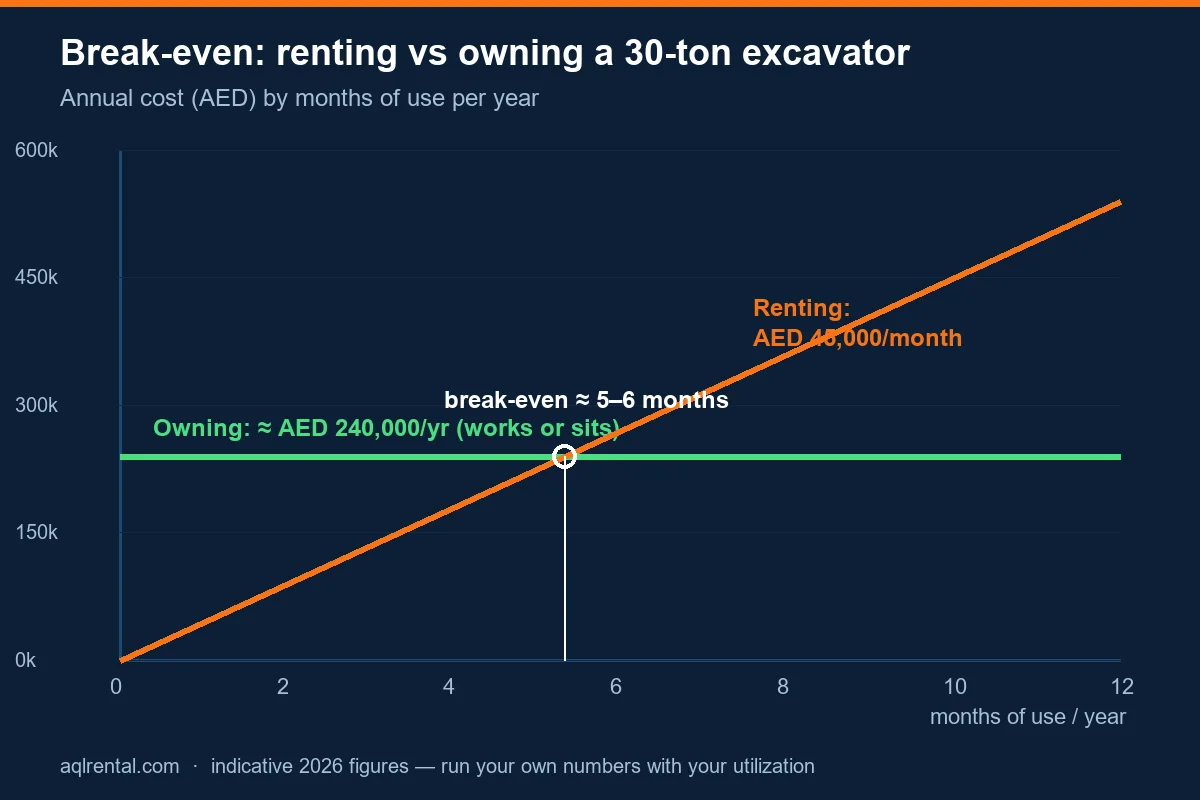
That's your break-even: if you need this excavator more than 5–6 months every year, year after year, ownership starts winning on paper. Factor in the hidden costs of ownership — downtime, an idle operator when the machine's in the workshop, the hassle of eventually selling it — and most fleet managers use a higher threshold: sustained utilization above 60–65% over a 3+ year horizon. Below 40%, renting wins every time. Between the two is where the rest of this guide earns its keep.
When Renting Heavy Equipment Wins
Your pipeline is uncertain. You've won a 7-month contract but don't know what comes after. Renting means the machine — and its cost — disappears the day the project ends. No asset sitting in your yard eating insurance while you chase the next award.
The project is short or specialized. Need a 50-ton crawler crane for a six-week lift program? Buying one for that is like buying a plane for one holiday. Rent it, use it, return it.
Capital is tight or better used elsewhere. AED 850,000 in an excavator is AED 850,000 not funding payroll, materials, or the mobilization costs of your next bid. For growing contractors, cash flexibility often beats asset ownership.
You want current technology without the commitment. Emissions standards, telematics, and fuel efficiency improve every model cycle. Renters get the newest machines by default; owners live with their purchase decision for a decade.
You'd rather not run a maintenance operation. With rental — especially wet hire — breakdowns, servicing, and certification are the supplier's problem. If a rented machine goes down, a decent supplier swaps it. If your owned machine goes down, your project waits and your mechanic bills you.
When Buying Heavy Equipment Wins
Renting isn't always the answer, and any rental company that tells you otherwise is selling, not advising.
The machine works nearly year-round. Remember the break-even: past 60–65% utilization sustained over years, ownership is cheaper. A grading contractor whose dozer works 10 months a year is giving away margin by renting it.
It's a core machine for your core business. If every job you take needs a backhoe, that backhoe is infrastructure, not a project expense. Availability matters too — you'll never call three suppliers during peak season to find your own machine.
You want full control. Modify it, brand it, run it whatever hours you like, and build equity in an asset with real resale value — heavy equipment holds value far better than vehicles, especially well-maintained machines in the active Gulf secondary market.
The honest downsides: depreciation is real money (15–25% gone in year one), technology moves on without you, you're now running a maintenance operation, and when you no longer need the machine, selling takes time and rarely fetches what you hoped.
The Options Nobody Talks About
The rent-or-buy construction equipment framing hides two paths that suit a lot of UAE contractors better than either extreme.
Leasing and lease-to-own
A lease gets you the machine for a fixed monthly payment over 2–5 years — lower than rental rates, without the upfront capital of buying. Lease-to-own arrangements apply part of each payment toward eventual ownership, which suits contractors who know they'll need the machine long-term but can't or won't tie up capital today.
For businesses that prefer Sharia-compliant structures, Ijarah financing — offered by most UAE Islamic banks — is effectively a lease: the bank buys the machine and leases it to you, often with an ownership transfer at the end. It's one of the most natural fits for equipment acquisition in the region, and almost no one writing about this topic mentions it.
Buying used
The UAE and wider GCC have one of the world's most liquid used-equipment markets, fed by fleet turnover and re-export trade. A well-maintained 5-year-old excavator at 40–50% of new price sidesteps the brutal early depreciation years while leaving plenty of working life. The caveats: inspect thoroughly (undercarriage, hydraulics, hour-meter honesty), buy from reputable dealers or established auctions, and budget more for maintenance than you would on new construction machinery.
Factors That Change the Math in the UAE
Generic advice written for American or European contractors misses three things that genuinely shift the calculation here.
Tax treatment: 9% corporate tax and 5% VAT
Since the UAE introduced corporate tax, the rent-vs-buy decision has a tax dimension it didn't have before. Rental payments are generally fully deductible operating expenses in the year you pay them. A purchased machine is capitalized and depreciated over several years — you get the deduction, but slowly. For a profitable contractor, renting front-loads the tax benefit. VAT at 5% applies on both rental invoices and purchases and is recoverable for registered businesses, but the cash-flow timing differs: 5% on a monthly rental invoice is a much smaller outlay than 5% on an AED 850,000 machine. This is general information, not tax advice — run your specific situation past your tax adviser and check the current rules at the UAE Federal Tax Authority.
Climate: heat, sand, and the summer clock
Gulf conditions are hard on construction machinery. Fine sand shortens the life of filters, undercarriages, and hydraulic seals; 45-degree summers punish cooling systems; and coastal humidity accelerates corrosion. Practical result: maintenance reserves that would be sensible in Europe are too low here, and machine lifespans run shorter. The summer midday work ban also compresses usable working hours for several months a year, cutting the utilization that ownership economics depend on. Both effects push marginal-utilization machines toward the rental column.
Compliance and certification
Cranes and lifting equipment in the UAE require third-party inspection and certification, operators need the right licenses, and municipalities and free zones apply their own rules — Trakhees in Dubai's ports and free-zone areas being the notable example. Moving oversized loads needs transport permits. When you rent from an established supplier, current certification typically comes with the machine. When you own, every certificate, renewal, and inspection is on your calendar and your budget. It's not a dealbreaker — thousands of contractors manage it — but it belongs in your cost comparison, and it rarely appears in one.
Rental Contract Fine Print: Check Before You Sign
Five minutes on these questions prevents most rental disputes:
- Wet or dry hire? Wet includes an operator (and often fuel); dry is the machine only. In the UAE, dozers and cranes usually go out wet; smaller machines vary. Confirm exactly what "with operator" includes — hours, overtime, accommodation.
- Who insures what? Clarify damage liability, deductibles, and whether you need to add the machine to your own contractor's plant insurance.
- What happens when it breaks? Get the replacement commitment in writing. "We'll swap it within 24 hours" is worth real money; "we'll send a mechanic when available" is not.
- Delivery, collection, and fuel policy. Per-trip transport charges of AED 800–2,500 each way add up on short hires. Confirm whether the machine arrives fueled and how usage is billed.
- Minimum periods and early return. If the project finishes early, do you keep paying?
Worked Example: One Project, Both Paths
A Dubai contractor wins a 9-month infrastructure package needing a 30-ton excavator and two mid-size wheel loaders.
Renting: excavator at AED 45,000/month plus two loaders at AED 18,000/month each comes to AED 81,000/month — AED 729,000 over nine months, transport and certification included, zero capital deployed, and the cost stops the day the job ends.
Buying: roughly AED 1.61M upfront (AED 850,000 excavator, AED 380,000 per loader). Nine months of insurance, maintenance, and transport adds around AED 90,000. Sell everything at project end at a realistic 18–20% below purchase price after transaction costs, and the net cost lands around AED 400,000 — plus nine months with AED 1.6M of working capital locked up, plus the risk that the machines take months to sell or fetch less than hoped.
On pure spreadsheet numbers, buying looks cheaper. Risk-adjusted, it's much closer than it appears: the buy path only wins if resale goes smoothly, and it turns your contracting business into a used-equipment seller at exactly the moment you're mobilizing the next job. Most contractors in this scenario rent — unless they know the machines roll straight onto another project, which changes the utilization picture entirely and makes buying the smarter call. That's the whole game: the answer follows the pipeline.
Decision Checklist: 8 Questions Before You Commit
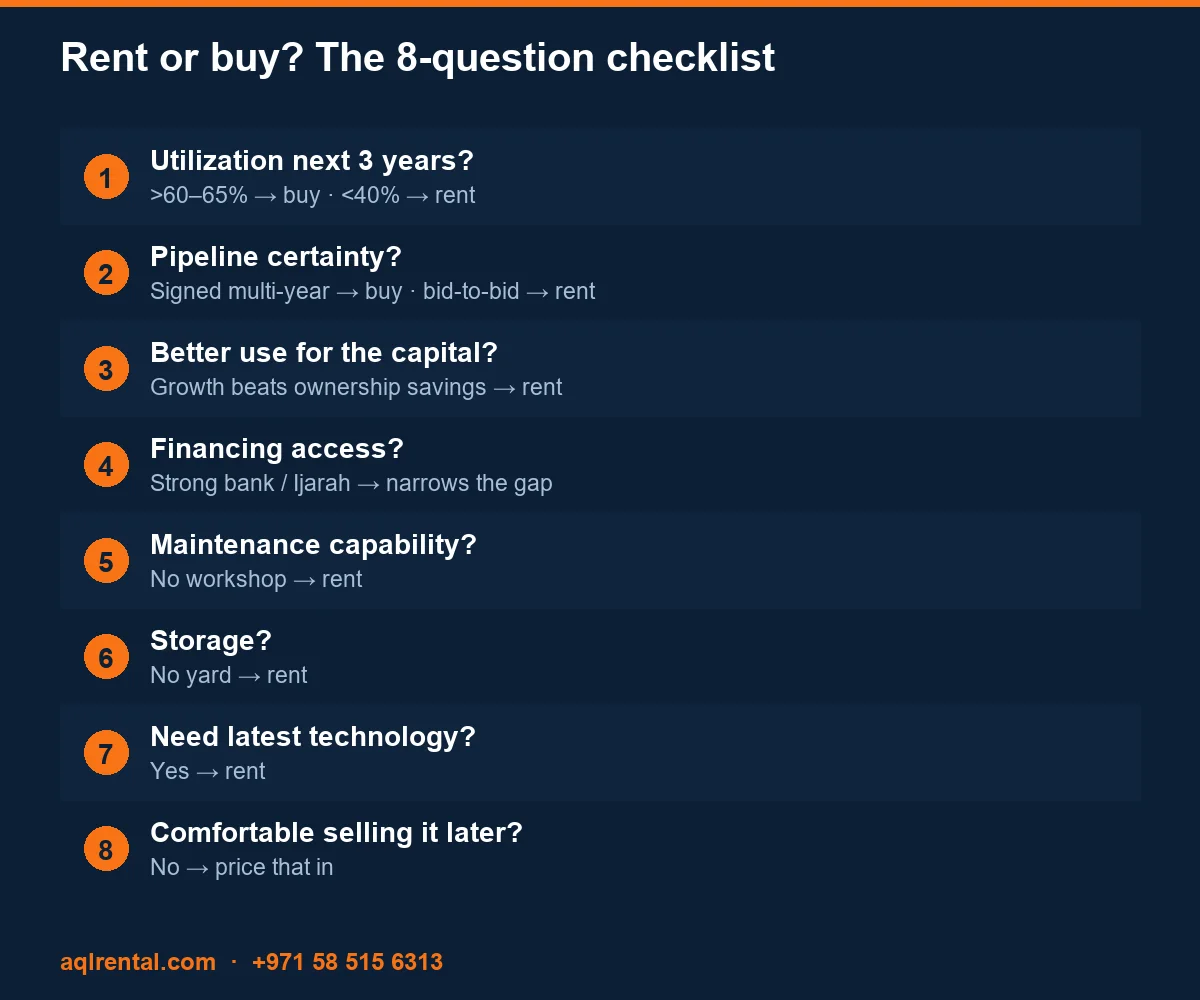
In the end, the renting vs buying heavy equipment decision is answered by your honest responses to these eight questions:
- What's this machine's utilization over the next 3 years? Above 60–65% → buying. Below 40% → renting. In between → keep reading.
- How certain is your project pipeline? Signed multi-year work favors owning; bid-to-bid uncertainty favors renting.
- What would the purchase capital otherwise do? If it funds growth that returns more than ownership saves, rent.
- Can you finance it well? A strong bank relationship or Ijarah facility narrows renting's cash-flow advantage.
- Can you maintain it? No workshop, no mechanic, no parts pipeline → the rental company's maintenance is worth paying for.
- Where would it live? Storage in the UAE isn't free, and machines parked in the open here age fast.
- Does the latest technology matter for your work? Emissions requirements and fuel costs favor renters who always get current models.
- Would you be comfortable selling it? Ownership ends with a sale. If that thought fills you with dread, price it in.
FAQ
Is it cheaper to rent or buy heavy equipment?
Renting is cheaper when a machine works less than about 40–50% of the time or when you need it for under 12–18 months. Buying becomes cheaper once utilization stays above roughly 60–65% for three or more years, because annual ownership costs (depreciation, finance, insurance, maintenance) fall below what year-round rental would cost.
What is the break-even point between renting and buying?
For a typical 30-ton excavator in the UAE, annual ownership costs run around AED 240,000 — equivalent to about 5–6 months of rental. If you'd rent the machine longer than that every year, ownership starts to win. Most fleet managers add a margin for downtime and resale risk and use 60–65% utilization as the practical threshold.
How much does it cost to rent an excavator in the UAE?
As of 2026, monthly rates run roughly AED 13,700–19,500 for a 10–20 ton machine, AED 27,500–39,000 for 20–30 tons, and AED 41,200–54,900 for 30–50 tons. Rates vary by emirate, duration, and whether hire is wet or dry, with transport charged separately. See current excavator rental rates for specific models.
Is renting heavy equipment tax deductible in the UAE?
Rental payments are generally deductible as operating expenses against the UAE's 9% corporate tax in the year incurred, while purchased equipment is capitalized and depreciated over time. VAT at 5% applies to both and is recoverable for registered businesses. Confirm your specific treatment with a tax adviser.
What's the difference between wet hire and dry hire?
Wet hire includes an operator and usually fuel; dry hire is the machine only. In the UAE, bulldozers and cranes are most commonly rented wet, while smaller machines are often available either way. Wet hire costs more per month but includes a licensed operator — which matters for certified lifting work.
Who pays for maintenance on rented equipment?
The rental company handles servicing and normal wear and tear. The renter is typically liable for damage from misuse, and fuel is usually the renter's cost on dry hire. Check the contract for how breakdowns are handled and how quickly a replacement machine is guaranteed.
What is lease-to-own for heavy equipment?
A lease-to-own agreement applies part of each monthly payment toward eventual ownership of the machine, usually over 2–5 years. It suits contractors who need a machine long-term but want to avoid a large upfront outlay. In the UAE, Sharia-compliant Ijarah financing from Islamic banks works on a similar lease-based structure.
Should a new construction company rent or buy equipment?
Rent first. A new contractor's pipeline is unproven and capital is scarce — exactly the conditions where renting wins. Track utilization on every rented machine; once one consistently exceeds 60% utilization across multiple projects, that's your signal to buy that specific machine.
The Bottom Line
Renting vs buying heavy equipment comes down to one number and one honest question: what's your real utilization, and how sure are you about it? High, certain utilization → buy (or lease-to-own). Low or uncertain → rent, and let someone else carry the depreciation, maintenance, and resale risk. And remember there are four paths, not two — rent, buy new, buy used, lease — and the best fleets in the UAE use a deliberate mix of all of them.
Not sure which side of the break-even you're on?
Send us your project details and we'll run the numbers with you — and tell you straight if buying makes more sense for your situation.